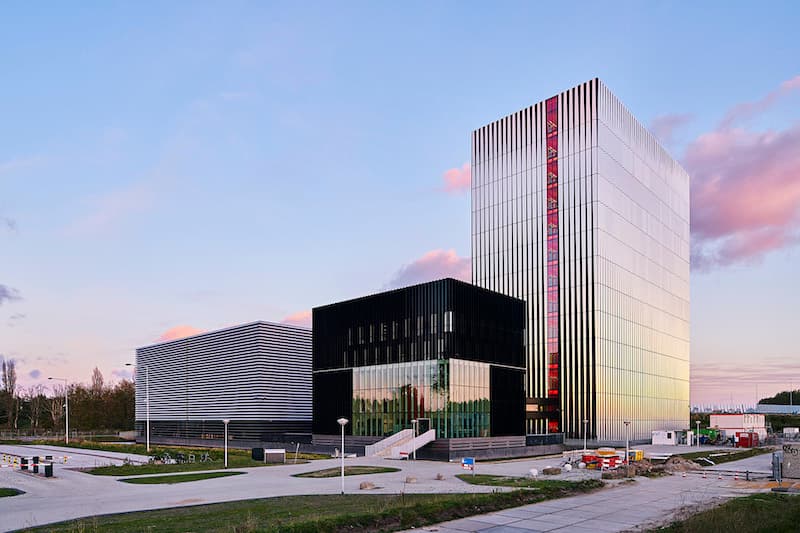
Last week, there was a public outrage after the Amsterdam police seized a server belonging to Autistici/Inventati (A/I), a former Italian web provider, at the request of the US government. The matter came to light after an employee of Waag was asked to collect the server. When it became apparent that the server had been seized by the police, without A/I having been notified, Waag's management informed journalists. Below, we briefly outline the events leading up to this and why Waag choses to go public.
The context
On 26 August this year, A/I was designated a ‘terrorist organisation’ by the US government. The Trump administration claimed that the collective managed the digital infrastructure of antifa cells. Ultimately, as a result of the sanctions, A/I was forced to disband. Under Italian law, the association used for administrative purpose by the collective (AI ODV) was now required to gather all its assets. Waag was asked to retrieve a server located in an Amsterdam data centre. However, before we could do so, it appeared that the server had already been seized by the police. It was unclear on what grounds. That was the reason for alerting journalists to the situation and, at AI ODV's request, seeking legal assistance. It was not until the following day that it became clear that the police were acting at the request of the US government. It remains unclear whether the Public Prosecution Service carried out its own assessment and why the organisation itself was not informed.
Chilling effect
This case makes it painfully clear just how great America’s (digital) power is. As a result of being placed on the terrorism list, customers were immediately prohibited from purchasing services from A/I. They lost the ability to receive donations because PayPal terminated its payment service, the domain name was taken offline and their Italian bank also terminated the partnership – all out of fear by the parties involved of secondary sanctions. This so-called ‘chilling effect’, whereby individuals and organisations choose not to exercise their legal rights under the threat of legal sanctions, indirectly led to the forced dissolution of the A/I collective.
Waag has made a conscious decision to speak out about the situation, as director Marleen Stikker previously told de Volkskrant. ‘We must not allow ourselves to be silenced out of fear of the power of Trump and America. It is precisely by bringing these kinds of abuses to light and taking collective action that we demonstrate that seeking to create such a chilling effect is unacceptable. A government must not deprive people of their rights. Our digital autonomy is at stake.’
Protection against sanctions-related pressure
On 17 September, PublicSpaces, together with Waag and 36 other organisations, sent a letter to the Dutch parliament calling for European organisations and their users to be protected against foreign sanctions pressure, as a direct response to the situation. The AI ODV Association has had no opportunity whatsoever to lodge an objection to the allegations made by the US against A/I and has been unable to secure an independent legal review. In an urgent letter on behalf of the Dutch cloud sector, the Dutch Cloud Community also highlights the impact of this situation on the business climate and service provision. ‘Without a clear Dutch review process, the Netherlands will lose the trust of the organisations and companies that store their data here,’ the organisation said in an interview with the NOS.
Protection must be put in place for organisations, along with a procedure enabling them to defend themselves against unjustified classifications and sanctions. ‘As an organisation, you need to know where to turn to raise an objection,’ says Stikker. ‘At present, there is no support system whatsoever, and this leads to uncertainty for organisations and entrepreneurs. If Europe does not stand up to this now, we are effectively surrendering our digital autonomy in advance.’ She is positive about the media interest and the involvement of political parties that have tabled questions in parliament. Meanwhile, the Public Prosecution Service and the police are hiding behind international treaties and have so far provided no insight whatsoever to those affected.
Read more:
The title Do Not Obey in Advance refers to the first principle from Timothy Snyder’s On Tyranny.
Parliamentary questions by Barbara Kathmann (PRO) and Sarah El Boujdaini (D66) on 10 September: The consequences of US sanctions policy for the European internet sector.
NRC on 14 October: Amsterdam police seize server from left-wing internet service provider A/I at the request of the US: organisation allegedly facilitates ‘antifa’
Volkskrant on 15 October: Dutch police seize server containing data from a ‘terrorist organisation’ following a US request: ‘Trump’s long arm’
Parliamentary questions by Christine Teunissen (PvdD) and Sarah Dobbe (SP) on 16 October: The seizure of a server by the Amsterdam police at the request of the US government.
Parliamentary questions by Barbara Kathmann (PRO) and Sarah El Boujdaini (D66) on 16 October: Facilitating the US request to seize a server belonging to a European internet company.